 |
undoStudio
The IDE of the undoRT ecosystem
|
|
undoStudio
The IDE of the undoRT ecosystem
|
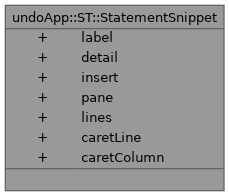
One statement skeleton the suggestion list can write out. More...
#include <undoAppSTSnippet.hpp>
Public Attributes | |
| std::string | label |
| What the list shows, e.g. "IF ... END_IF". | |
| std::string | detail |
| Dimmed right-hand column: what it is for. | |
| std::string | insert |
| Keyword written when the skeleton is accepted. | |
| SnippetPane | pane = SnippetPane::Body |
| std::vector< std::string > | lines |
| Template lines, "\t" for one indent step. | |
| int | caretLine = 0 |
| Template line the caret lands on. | |
| int | caretColumn = 0 |
| Caret column, before the base indentation. | |
One statement skeleton the suggestion list can write out.
The template is stored the way the statement reads, indented relative to the line the caret is on, so a nested skeleton is a matter of indenting the template rather than rewriting it. A "\t" in the template stands for one indent step and is widened to the editor's tab size on the way out.
The caret is stated against the template: caretLine counts template lines from zero, and caretColumn counts glyphs into that line before the base indentation is prepended. There is no placeholder character in the written text; the caret is placed inside it.
| int undoApp::ST::StatementSnippet::caretColumn = 0 |
Caret column, before the base indentation.
| int undoApp::ST::StatementSnippet::caretLine = 0 |
Template line the caret lands on.
| std::string undoApp::ST::StatementSnippet::detail |
Dimmed right-hand column: what it is for.
| std::string undoApp::ST::StatementSnippet::insert |
Keyword written when the skeleton is accepted.
| std::string undoApp::ST::StatementSnippet::label |
What the list shows, e.g. "IF ... END_IF".
| std::vector<std::string> undoApp::ST::StatementSnippet::lines |
Template lines, "\t" for one indent step.
| SnippetPane undoApp::ST::StatementSnippet::pane = SnippetPane::Body |
 1.9.8