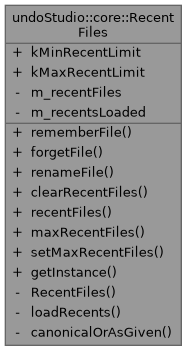
Which files were opened recently.
More...
#include <RecentFiles.hpp>
|
| void | rememberFile (const std::string &filePath) |
| | Record that a file was opened.
|
| |
| void | forgetFile (const std::string &filePath) |
| | Forget one file.
|
| |
| void | renameFile (const std::string &oldPath, const std::string &newPath) |
| | Point a remembered file at where it moved to.
|
| |
| void | clearRecentFiles () |
| | Empty the list.
|
| |
| const std::vector< std::string > & | recentFiles () const |
| | The files opened recently, newest first.
|
| |
| size_t | maxRecentFiles () const |
| | How many files to remember.
|
| |
| void | setMaxRecentFiles (size_t count) |
| | Set how many files to remember, trimming the list at once.
|
| |
|
| static constexpr size_t | kMinRecentLimit = 1 |
| | The smallest limit that may be stored.
|
| |
| static constexpr size_t | kMaxRecentLimit = 100 |
| | The largest limit that may be stored.
|
| |
|
| static std::string | canonicalOrAsGiven (const std::string &filePath) |
| | Read the list from disk unless it has been read already.
|
| |
|
| std::vector< std::string > | m_recentFiles |
| | Remembered files, newest first. Mutable because reading the list fills it.
|
| |
| bool | m_recentsLoaded = false |
| | Whether the list has been read from disk in this process.
|
| |
Which files were opened recently.
A singleton, because the list belongs to the IDE and not to any one undoApp: the menu that shows it is the core's, and a plugin that kept its own copy would write a list that the menu could not see.
◆ RecentFiles()
| undoStudio::core::RecentFiles::RecentFiles |
( |
| ) |
|
|
privatedefault |
◆ canonicalOrAsGiven()
| std::string undoStudio::core::RecentFiles::canonicalOrAsGiven |
( |
const std::string & |
filePath | ) |
|
|
staticprivate |
Read the list from disk unless it has been read already.
Canonical path, or the one as given when it does not resolve
◆ clearRecentFiles()
| void undoStudio::core::RecentFiles::clearRecentFiles |
( |
| ) |
|
◆ forgetFile()
| void undoStudio::core::RecentFiles::forgetFile |
( |
const std::string & |
filePath | ) |
|
Forget one file.
- Parameters
-
| filePath | Path to drop from the list |
◆ getInstance()
| RecentFiles & undoStudio::core::RecentFiles::getInstance |
( |
| ) |
|
|
static |
◆ loadRecents()
| void undoStudio::core::RecentFiles::loadRecents |
( |
| ) |
const |
|
private |
◆ maxRecentFiles()
| size_t undoStudio::core::RecentFiles::maxRecentFiles |
( |
| ) |
const |
How many files to remember.
- Returns
- The limit, never below one and never above the maximum
◆ recentFiles()
| const std::vector< std::string > & undoStudio::core::RecentFiles::recentFiles |
( |
| ) |
const |
The files opened recently, newest first.
Loads the list from the state file the first time it is asked for, so a fresh process sees the entries a previous one left. Reading is const and mutates the cache, which is why the cache is mutable and why the flag saying whether it is loaded is too.
- Returns
- The remembered paths, possibly empty
◆ rememberFile()
| void undoStudio::core::RecentFiles::rememberFile |
( |
const std::string & |
filePath | ) |
|
Record that a file was opened.
Moves rather than repeats: the list is ordered by when a file was last looked at, and an entry appearing twice is the first thing a user notices about it.
The path is canonicalised so that one file reached by two routes is one entry. A path that does not resolve — a file deleted between being listed and being opened — is recorded as it was given rather than dropped: the list is a history, and refusing to remember something is a worse answer than remembering it in a form that no longer opens.
- Parameters
-
| filePath | Absolute path of the file that was opened |
◆ renameFile()
| void undoStudio::core::RecentFiles::renameFile |
( |
const std::string & |
oldPath, |
|
|
const std::string & |
newPath |
|
) |
| |
Point a remembered file at where it moved to.
In place, keeping its position, so a rename does not make an old file the newest thing in the list. A deleted file is left alone instead: the list is a history, and the missing mark is the honest answer for one that is gone.
- Parameters
-
| oldPath | The path the entry was recorded under |
| newPath | Where the file now is |
◆ setMaxRecentFiles()
| void undoStudio::core::RecentFiles::setMaxRecentFiles |
( |
size_t |
count | ) |
|
Set how many files to remember, trimming the list at once.
Trimmed here rather than at the next rememberFile(), because a limit lowered from fifty to five should leave five entries rather than fifty of which forty-five appear in no list and go on being written to the file.
- Parameters
-
| count | The limit to store, clamped to the allowed range |
◆ kMaxRecentLimit
| constexpr size_t undoStudio::core::RecentFiles::kMaxRecentLimit = 100 |
|
staticconstexpr |
The largest limit that may be stored.
◆ kMinRecentLimit
| constexpr size_t undoStudio::core::RecentFiles::kMinRecentLimit = 1 |
|
staticconstexpr |
The smallest limit that may be stored.
◆ m_recentFiles
| std::vector<std::string> undoStudio::core::RecentFiles::m_recentFiles |
|
mutableprivate |
Remembered files, newest first. Mutable because reading the list fills it.
◆ m_recentsLoaded
| bool undoStudio::core::RecentFiles::m_recentsLoaded = false |
|
mutableprivate |
Whether the list has been read from disk in this process.
The documentation for this class was generated from the following files:

 1.9.8